
Table of Contents
A few months ago, I passed the AWS Certified AI Practitioner exam.
Naturally, I thought:
"Okay… maybe I'm getting pretty good at AWS now."
Then I started preparing for the AWS Certified Solutions Architect – Associate (SAA-C03).
AWS responded:
"That's cute."
😂
SAA was a completely different experience.
VPCs, NAT Gateways, Load Balancers, Route 53, RDS, DynamoDB, SQS, CloudFront, Global Accelerator, Direct Connect…
And somehow half of AWS seemed capable of solving the exact same problem.
But after weeks of studying, multiple practice exams, a few exam reschedules, and a lot of:
"WHY ISN'T THIS ANSWER B?"
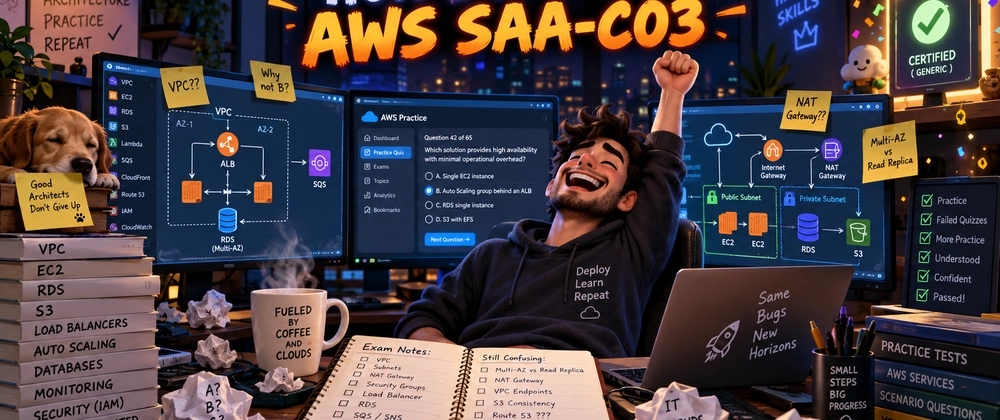
…I finally passed the AWS Certified Solutions Architect – Associate on September 10, 2026. 🎉
Here's what actually helped me.

SAA is very different from AI Practitioner
With AI Practitioner, a lot of the challenge was understanding what each AWS AI service does.
SAA is much more about:
Which architecture is the best solution for this exact scenario?
Knowing that RDS is a database isn't enough.
You need to understand:
- Multi-AZ vs Read Replica
- ALB vs NLB
- EBS vs EFS vs FSx
- SQS vs SNS vs EventBridge
- CloudFront vs Global Accelerator
- NAT Gateway vs VPC Endpoint
- DataSync vs Storage Gateway
That became my biggest study lesson:
Don't memorize Service → Definition.
Learn:
Requirement → Best AWS Service
That mindset made SAA much easier.
What "Requirement → Service" looks like
To make that concrete, here are some of the classic pairs from the list above, written the way the exam tends to frame them — as a requirement first:
| If the scenario says… | Think… |
|---|---|
| Survive an AZ failure with automatic database failover | RDS Multi-AZ |
| Scale out read-heavy database traffic | RDS Read Replicas |
| Route HTTP requests by path or hostname | ALB |
| Extreme performance, TCP/UDP, or a static IP per AZ | NLB |
| Block storage attached to a single EC2 instance | EBS |
| Shared Linux file system across many instances and AZs | EFS |
| Windows file shares or high-performance (Lustre) file systems | FSx |
| Decouple producers and consumers with a buffer | SQS |
| Fan out one message to many subscribers | SNS |
| Route events by rules, including from SaaS and AWS services | EventBridge |
| Cache content close to users at the edge | CloudFront |
| Static anycast IPs and faster global routing for non-HTTP workloads | Global Accelerator |
| Private-subnet instances need outbound internet access | NAT Gateway |
| Reach S3 or DynamoDB privately, without going over the internet | VPC Endpoint |
| Move large amounts of data into AWS storage | DataSync |
| On-premises apps need ongoing access to cloud storage | Storage Gateway |
Once you start reading questions this way, a lot of the "four valid answers" problem becomes "one answer that fits the keywords, and three that almost do."
My main course
My primary learning resource was Stéphane Maarek's AWS Certified Solutions Architect Associate course:
🔗 AWS Certified Solutions Architect Associate (SAA-C03) on Udemy
I used it to build my foundation across the major topics:
- EC2
- VPC
- IAM
- S3
- RDS / Aurora
- DynamoDB
- Route 53
- Load Balancing
- Auto Scaling
- SQS / SNS
- CloudFront
- Containers
- Serverless
- Storage
- Security
- Disaster Recovery
One thing I would recommend:
Don't rush through the videos just to finish the course.
Try to understand why each service exists.
Eventually, instead of seeing 20 separate AWS products, you start seeing actual architectures.
I created 21 revision cards
My notes eventually became way too big.
So I compressed almost everything into 21 revision cards, covering areas such as:
- IAM
- VPC
- Security
- ELB + Auto Scaling
- Route 53
- S3
- EC2
- RDS
- DynamoDB
- Messaging
- Serverless
- Disaster Recovery
- Analytics
- Migration
- Cost Optimization
The goal was simple:
"Can I refresh an entire topic in five minutes?"
These became extremely useful during the final few days.

The trick with cards like these is to keep them about decisions, not definitions. A good card isn't "SQS is a message queue" — it's "SQS when I need to decouple and buffer; SNS when I need to fan out; EventBridge when I need rules-based routing."

ChatGPT became my AWS study buddy again 😂
If you read my previous AI Practitioner article, you already know this character.
ChatGPT returned for Season 2.
I used it mainly to understand why I got things wrong.
Instead of asking:
"What is SQS?"
I would ask:
"Give me an SAA scenario where SQS is correct, but SNS and EventBridge look tempting."
Or:
"Why is this CloudFront and not Global Accelerator?"
"Explain NAT Gateway like I'm five."
"Give me 10 hard questions about DynamoDB."
That helped me understand the differences between similar AWS services instead of just memorizing definitions.
Practice exams were where the real learning happened
Watching tutorials made me feel smart.
Practice exams corrected that misunderstanding very quickly. 😂
These were the main resources I used:
Stéphane Maarek practice exams
🔗 Practice Exams: AWS Certified Solutions Architect Associate on Udemy
These helped expose gaps in my knowledge pretty quickly.
Tutorials Dojo free SAA sampler
🔗 Tutorials Dojo free SAA-C03 practice exam sampler
A different question style, which helped stop me getting too comfortable with questions from a single source.
YouTube full practice exam
🔗 Full SAA-C03 practice exam on YouTube
My process:
Pause → Answer → Resume → Realize I was confidently wrong → Learn → Continue.
CloudNinja
🔗 CloudNinja Solutions Architect practice tests
I used CloudNinja during my AI Practitioner preparation too, so naturally it returned for round two.
The biggest improvement: tracking my mistakes
Instead of only checking the final mock score, I started tracking why I got each question wrong.
Usually it was one of these:
- I genuinely didn't know the concept.
- I confused two similar services.
- I missed an important keyword.
- I guessed correctly.
That last one is important.
A correct guess is still:
a knowledge gap wearing sunglasses. 😎
If I guessed a question correctly, I still reviewed it.
Eventually, my wrong answers became my personal study guide:
- Kept failing VPC questions? Study VPC.
- DynamoDB kept destroying me? More DynamoDB.
Much better than restarting the entire course.
The categories also tell you how to fix each gap. A missing concept means going back to the course; confusing two services means building a side-by-side comparison; missing a keyword means slowing down and re-reading the question for words like "cost-effective", "least operational overhead" or "highly available".
Then I accidentally built an SAA practice app 😂
This part got slightly out of control.
While preparing, I kept thinking:
"I just want a simple place where I can open the browser and immediately practice SAA questions."
No unnecessary setup.
No complicated dashboards.
Just:
Open → Answer → Get destroyed by AWS → Learn → Repeat
And because I'm a developer…
Instead of simply accepting this minor inconvenience like a normal human being…
I built a web app.

What started as:
"I'll make something tiny for myself."
quickly became:
"Okay… it should probably have exam mode."
Then:
"It obviously needs shuffled questions."
Then:
"Quick practice would be useful."
Then:
"Well, I might as well deploy it."
And somehow my certification preparation turned into another software project. 😂
🚀 SAA-C03 Practice Exam
I originally built it for myself, but then realized other SAA candidates could use it too.
It currently includes:
- realistic exam practice
- full practice mode
- quick practice
- randomized questions
- answer explanations
Basically:
I started studying for an AWS certification and accidentally shipped a product.
Very developer behavior.
My final few days
During the last few days, I stopped trying to learn everything.
Instead, I focused on:
- revision cards
- wrong questions
- guessed questions
- service comparisons
- focused practice on weak areas
If networking was hurting me…
I did more networking.
Unfortunately:
Avoidance is not an AWS architecture strategy.
Exam day
On September 10th, I finally took the exam.
Some questions were straightforward.
Others felt like AWS had created four perfectly valid architectures and asked:
"Which one has achieved spiritual enlightenment?"
My approach was:
- Identify the requirement.
- Look for keywords.
- Eliminate obviously wrong answers.
- Compare the remaining options.
- Flag difficult questions and move on.
When the exam ended, I didn't immediately see the result.
Just, basically:
"Thank you for taking the exam."
AWS…
I require slightly more information than that. 😂
Eventually, the email arrived.
PASS. 🎉

What actually helped me pass
If I had to summarize everything:
1. Learn the fundamentals
Understand what each major AWS service actually solves.
2. Compare similar services
SAA loves testing overlapping services.
3. Practice scenario questions
A lot.
4. Review wrong AND guessed answers
This was probably the biggest improvement in my preparation.
5. Ask "Why?"
Don't only ask:
"Why is B correct?"
Also ask:
"Why are A, C and D wrong?"
That's where the real learning happens.
Would I recommend SAA to developers?
Absolutely.
Even if you don't plan to become a Solutions Architect.
As developers, we usually think:
"How do I implement this?"
SAA forces you to think:
"How should the entire system be designed?"
You start thinking more about scalability, availability, networking, security, storage, databases, disaster recovery and cost.
For me, that architectural mindset was probably more valuable than the certification itself.
Wrapping up
My entire preparation process can basically be summarized as:
Learn → Compare → Practice → Fix Weaknesses → Repeat
I postponed the exam.
I struggled with some practice tests.
I repeatedly confused AWS services.
I asked ChatGPT the same questions more times than I'd like to admit.
And somehow I built an SAA practice app along the way.
But eventually…
AWS Certified Solutions Architect – Associate ✅
Two AWS certifications down.
One random practice app shipped.
And apparently I still haven't learned how to stop signing up for certification exams.
So…
on to the next one. 😄🚀
If you're preparing for SAA-C03, you can also try the practice app I built during this slightly unhealthy AWS obsession 😂:
Good luck — and remember:
A wrong practice question today is much better than a wrong question on exam day.
Originally published on dev.to.