Table of Contents
AI coding tools have changed.
A couple of years ago, we got excited when autocomplete correctly guessed the next three lines.
Now we casually type:
"Refactor this module, update the tests, fix whatever breaks, and don't destroy production."
…and go make coffee.
In 2026, three names keep coming up whenever people talk about terminal-based AI coding agents:
- Claude Code
- Qwen Code
- OpenAI Codex
All three can explore your codebase, edit files, run commands, execute tests, and attempt to recover when things inevitably catch fire.
 GIF via GIPHY
But they have very different personalities.
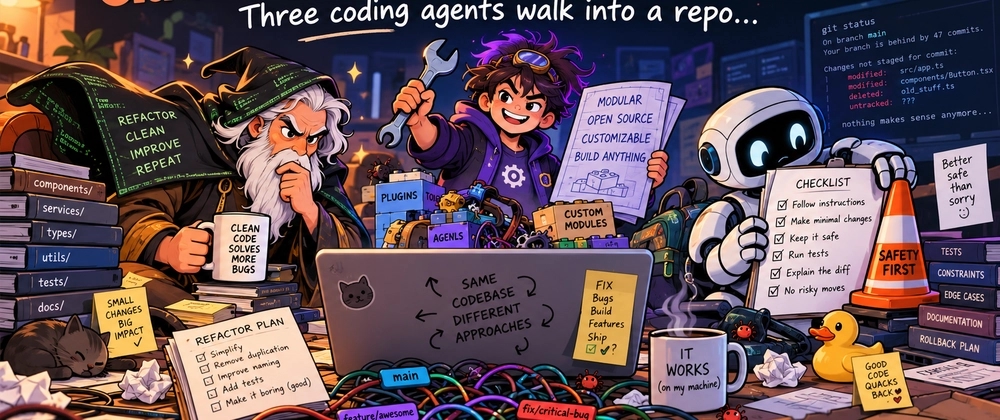
If I had to describe them as developers:
- Claude Code — the senior engineer who disappears for 30 minutes and comes back with the entire refactor done.
- Qwen Code — the open-source wizard who has a home lab and refuses to pay for SaaS subscriptions.
- Codex — the security-conscious engineer who asks, "Are you sure?" before touching anything remotely suspicious.
So which one should you actually use?
Let's compare them without turning this into a 40-page Gartner report.
Claude Code
Claude Code is Anthropic's terminal-native coding agent.
Its biggest strength is working with large, messy codebases, where a single change touches multiple files, services and tests, and probably one mysterious utility written by someone who left the company three years ago.
Claude Code supports things like:
- Subagents
- Hooks
- MCP integrations
- Project instructions
- Permission controls
- Reusable skills and workflows
Subagents are particularly interesting
Instead of forcing one giant AI context to understand everything, Claude Code can spin up separate agents to investigate different parts of the codebase.
- One agent can inspect the database layer.
- Another can investigate the frontend.
- Another can figure out why
UserServiceFinalV2_NEW.tsexists.
The main agent then receives the useful findings without filling its own context window with every single detail. That becomes extremely useful for larger refactoring tasks, where context is the scarcest resource you have.
You can also define your own specialized subagents as Markdown files inside your project's .claude/agents/ folder (docs). A minimal one looks something like this:
---
name: db-investigator
description: Investigates the database layer, schemas and migrations. Use for any question about how data is stored.
tools: Read, Grep, Glob
---

You are a database specialist. Trace how the requested data flows through
models, repositories and migrations, and report back a short summary with
file paths. Do not modify any files.
Giving a subagent read-only tools like this is a nice way to let it explore freely without any risk of it "helpfully" editing things.
Where Claude Code shines
Claude Code is particularly strong at:
- Understanding unfamiliar repositories
- Large multi-file refactors
- Debugging complex systems
- Planning before modifying code
- Keeping track of long-running tasks
Its benchmark performance is also generally among the strongest of the three for software-engineering tasks.
The downside?
Your wallet may notice
Claude Code is primarily tied to Anthropic's paid plans and API usage.
You get a polished experience and powerful models, but this isn't the tool you choose because you're trying to run your AI engineering department for the price of a Netflix subscription.
Qwen Code
Qwen Code is the interesting one.
Why?
Because unlike Claude Code and Codex, you can actually own the setup.
Qwen Code is open source under Apache 2.0 (GitHub) and works with the Qwen Coder model family.
But the really useful part is that you're not locked into Qwen models. Depending on your configuration, Qwen Code can work with multiple API protocols and model providers — its README lists OpenAI, Anthropic, Gemini and Qwen APIs, plus local models via Ollama or vLLM.
That means you can potentially run it using:
- Alibaba Cloud models
- OpenAI-compatible APIs
- Anthropic-compatible APIs
- Local models through tools such as Ollama
- Self-hosted models through vLLM
Basically:
"Bring your own model."
Which is a sentence infrastructure engineers absolutely love.
Self-hosting changes the equation
With Claude Code and Codex, the provider controls the model infrastructure.
With Qwen Code, you can run much more of the stack yourself.
For companies worried about:
- Vendor lock-in
- Data privacy
- API costs
- Internal infrastructure
- Custom models
…that is a pretty big deal. If your code is never allowed to leave your network, "point the agent at a model running on our own GPUs" is a very different conversation from "please approve this new SaaS vendor".
Qwen Code also includes features such as subagents and experimental multi-agent workflows.
And benchmark results have become surprisingly competitive.
Open models used to feel like:
"It's not as good, but hey, it's free."
That argument is getting harder to make. The gap between open and closed coding models is shrinking quickly.
The trade-off
You get flexibility.
But flexibility sometimes means configuration.
Claude Code gives you a carefully designed Anthropic experience. Qwen Code gives you more knobs.
And developers love knobs — until it's 2:14 AM and one of those knobs is the reason nothing works.
Codex
Then we have OpenAI Codex.
Codex is interesting because it takes a slightly more cautious approach to autonomous coding. Its CLI is also open source under Apache 2.0 (GitHub), even though the models behind it are not.
Its architecture puts a lot of emphasis on:
- Sandboxing
- Approval policies
- Workspace permissions
- Controlled command execution
- Persistent project instructions
For example, you can configure whether Codex can:
- Only read files
- Modify files inside the workspace
- Execute commands
- Access external resources
- Require approval before certain actions
In practice, much of this comes down to two settings in ~/.codex/config.toml — a sandbox mode (read-only, workspace-write or danger-full-access) and an approval policy:
# ~/.codex/config.toml
# Let Codex edit files inside the project, but ask before anything riskier
sandbox_mode = "workspace-write"
approval_policy = "on-request"
Which makes Codex feel slightly less like:
"Go fix everything."
…and more like:
"You may fix everything inside this clearly marked safety zone."
 GIF via GIPHY
For individual developers, that can sometimes feel conservative.
For companies with security teams?
That's called a feature.
Where Codex shines
Codex works particularly well for:
- Terminal-heavy workflows
- Structured engineering tasks
- Repository automation
- Security-conscious teams
- Organizations already using ChatGPT/OpenAI heavily
Its AGENTS.md system is also useful for storing repository-specific instructions. (Claude Code has the same idea with CLAUDE.md.)
You can define things like:
- Run tests before committing.
- Never modify generated files.
- Use pnpm instead of npm.
- Do not touch production configuration.
Which is great, because apparently we now need to explain coding standards to both humans and robots.
Claude Code vs Qwen Code vs Codex at a glance
Here's the shorter version.
| Feature | Claude Code | Qwen Code | Codex |
|---|---|---|---|
| Company | Anthropic | Alibaba / Qwen | OpenAI |
| Open source | ❌ No (proprietary CLI, closed models) | ✅ Yes | CLI open source, models closed |
| Self-host models | Limited | ✅ Strong | Limited |
| Large refactors | Excellent | Very good | Very good |
| Terminal workflows | Excellent | Excellent | Excellent |
| Subagents | ✅ | ✅ | Agent workflows |
| Vendor flexibility | Low | High | Low |
| Security controls | Good | Configurable | Strong |
| Setup simplicity | Easy | More configuration | Easy |
| Best for | Complex codebases | Flexibility + cost control | Controlled automation |
Benchmark numbers change ridiculously fast, so I wouldn't choose a coding agent because one scored 74.2% instead of 72.8% on a benchmark last Tuesday.
Your repository is not SWE-bench.
Unfortunately.
Which one should you choose?
The answer depends more on your constraints than on the model leaderboard.
Choose Claude Code if…
You regularly work on complicated repositories and want the AI to understand large amounts of context with minimal babysitting.
It is especially attractive for:
- Large refactors
- Architecture changes
- Debugging unfamiliar systems
- Multi-file feature development
Claude Code currently feels the closest to giving a capable senior developer a terminal and saying:
"Figure it out."
Choose Qwen Code if…
You care about:
- Open source
- Self-hosting
- Cost control
- Model flexibility
- Avoiding vendor lock-in
Qwen Code is probably the most interesting option for developers who enjoy controlling their own infrastructure.
And the important change in 2026 is that choosing the open option no longer automatically means accepting terrible coding performance.
That's a big shift.
Choose Codex if…
You already live in the OpenAI ecosystem, or you want strong controls around what an agent is allowed to do.
Its sandboxing and approval model makes it especially attractive for teams where:
rm -rf /should perhaps require more than an AI saying:
"This seems reasonable."
Codex is a strong fit for structured terminal workflows and organizations that need predictable permission boundaries.
So… who wins?
Annoyingly, nobody.
And that's actually good.
If I had to summarize the three:
Claude Code → Give me the hardest coding task.

Qwen Code   → Give me control of the entire stack.

Codex       → Tell me exactly what I'm allowed to touch.
Claude Code is extremely strong for complex engineering work.
Qwen Code gives developers something the other two don't: real infrastructure and model freedom.
Codex provides a polished agent experience with particularly strong sandboxing and workflow controls.
But there's another option people sometimes forget.
Use more than one
I increasingly think AI coding tools will end up looking like normal developer tooling.
You don't ask:
"Should I use Git or Docker?"
You use the right tool for the job.
The same thing may happen with coding agents. You might use Qwen for inexpensive experimentation, Claude Code for a painful refactor, and Codex for tasks where you want tighter execution controls.
Conveniently, the project-instruction files are similar enough (CLAUDE.md, AGENTS.md) that keeping your team's conventions in sync across tools is mostly a copy-paste job.
And then you still manually review the pull request because, despite everything we've accomplished in AI…
// TODO: fix later…is somehow still alive.
Wrapping up
Key takeaways:
- Claude Code is the pick for large, messy, multi-file work where deep context and planning matter most — if you're happy to pay for it.
- Qwen Code is the pick when you want open source, self-hosting, model choice and cost control — if you're happy to configure it.
- Codex is the pick when you want clear sandboxing and approval boundaries — if you're happy to work inside them.
- Don't choose based on last week's benchmark. Choose based on your constraints: budget, privacy, infrastructure and how much risk your team can tolerate.
- Mixing tools is a perfectly valid strategy.
The most interesting question in 2026 isn't:
Which AI coding agent is the smartest?
It's:
How much autonomy are you comfortable giving one?
Models will keep improving. Benchmarks will keep changing. Prices will keep changing.
And developers will continue arguing about which tool is best on Reddit.
Some traditions are simply too important for AI to replace.
Originally published on dev.to.
