
Table of Contents
Every app eventually has to answer the same question: can I trust this data?
Form inputs, API request bodies, third-party responses: all of it needs validating before it reaches your business logic. Three popular JavaScript options are Yup, Zod and Joi, and choosing between them isn't always obvious.
In this article, I'll go through each library's features with code examples, then compare their strengths and weaknesses to help you make an informed decision for your projects.
Yup: elegant and easy
Yup is a simple and elegant library for data schema validation. It provides a declarative API, which makes validation rules easy to read and understand. Its lightweight nature makes it a great choice for smaller projects or scenarios where performance is critical.
Example usage
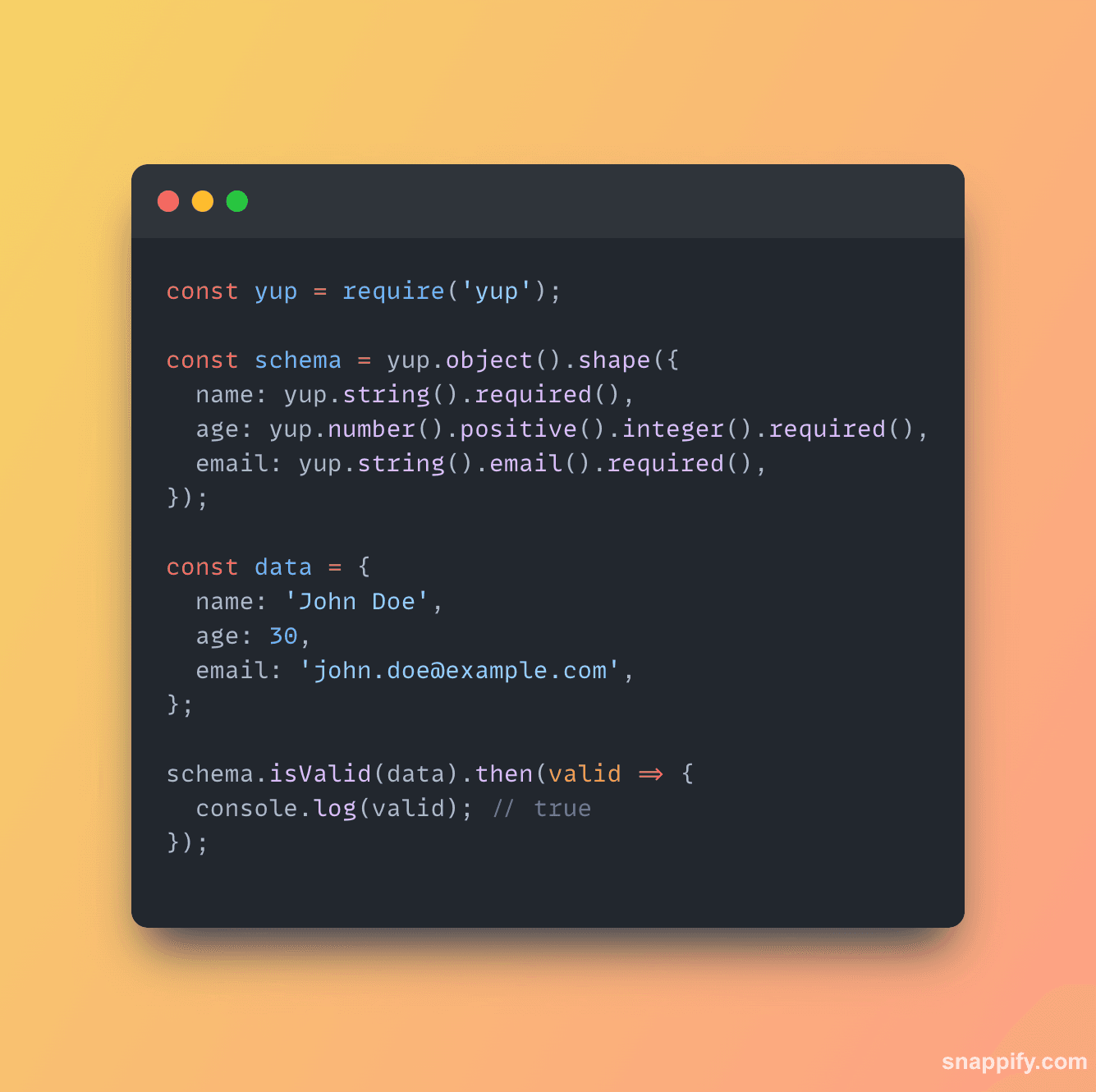
Here's a comparable schema in copy-friendly form:
import * as yup from 'yup'

const userSchema = yup.object({
  name: yup.string().min(2).required(),
  email: yup.string().email().required(),
  age: yup.number().integer().positive(),
})

type User = yup.InferType<typeof userSchema>

try {
  const user = await userSchema.validate(input, { abortEarly: false })
} catch (err) {
  console.log(err.errors) // array of human-readable messages
}
Pros:
- Declarative syntax for easy-to-read validation rules.
- Lightweight and fast for small to medium-sized projects.
- Good community support and actively maintained.
Cons:
- Lacks complex validation features for more extensive projects.
- Limited ecosystem compared to other libraries.
Zod: powerful and type-safe
Zod is a powerful validation library that shines in its ability to leverage TypeScript's type system. If you're using TypeScript, Zod's type inference ensures that your validation code is type-safe, which gives you extra confidence in how you handle data.
The big idea is that you write the schema once and get the TypeScript type for free, so your runtime checks and your static types can never drift apart.
Example usage
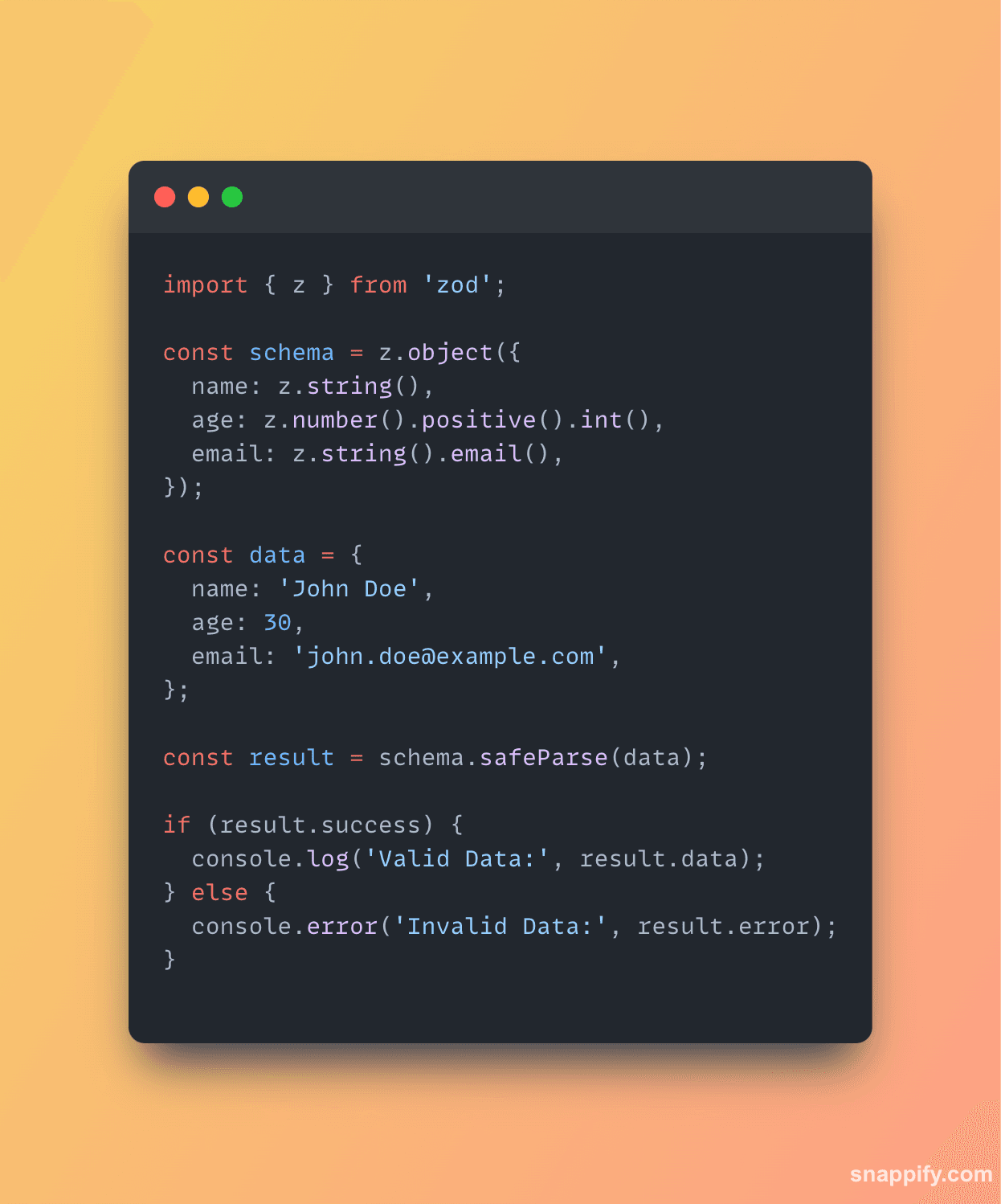
And a comparable schema as text:
import { z } from 'zod'

const userSchema = z.object({
  name: z.string().min(2),
  email: z.string().email(),
  age: z.number().int().positive().optional(),
})

// The type is derived from the schema, no duplication needed
type User = z.infer<typeof userSchema>

const result = userSchema.safeParse(input)

if (!result.success) {
  console.log(result.error.issues)
} else {
  const user: User = result.data
}
Pros:
- Strong TypeScript support for type-safe validation.
- Powerful validation capabilities and a rich validation API.
- Excellent error messages and error handling.
Cons:
- A learning curve for developers unfamiliar with TypeScript.
- Might add overhead for projects not using TypeScript.
Joi: feature-rich and battle-tested
Joi is a mature and feature-rich validation library, often used in Node.js applications. It provides a wide range of validation rules and customization options, making it suitable for complex validation scenarios.
Example usage
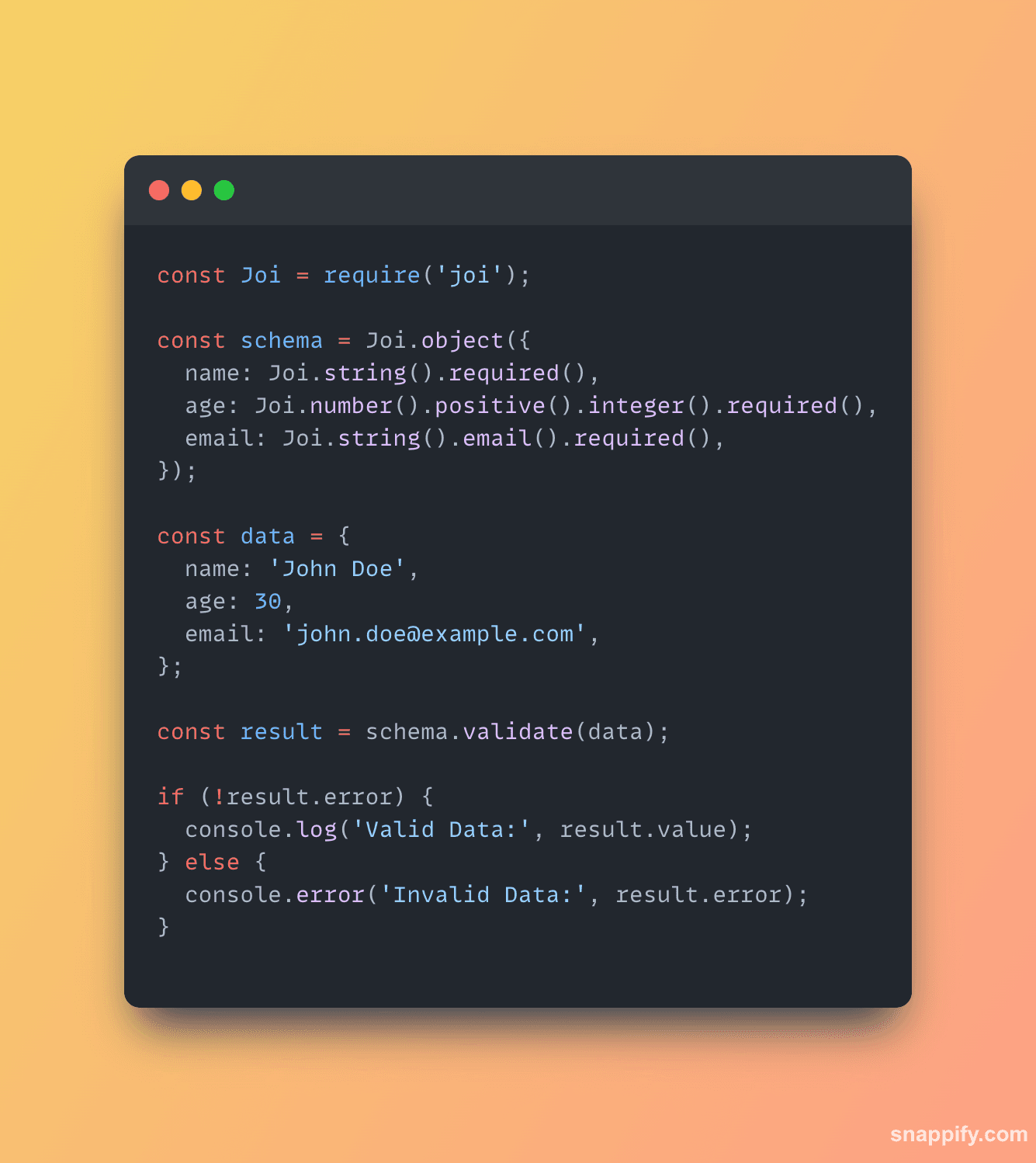
The same idea in copy-friendly form:
const Joi = require('joi')

const userSchema = Joi.object({
  name: Joi.string().min(2).required(),
  email: Joi.string().email().required(),
  age: Joi.number().integer().positive(),
})

const { error, value } = userSchema.validate(input, { abortEarly: false })

if (error) {
  console.log(error.details.map((detail) => detail.message))
}
Pros:
- Battle-tested and widely used in the Node.js ecosystem.
- Extensive set of validation rules and options.
- Robust error handling and customization capabilities.
Cons:
- Bulkier, and can add some overhead to smaller projects.
- May require more effort for type safety in TypeScript projects.
Side-by-side comparison
Here's how I see the three libraries stacking up:
| Yup | Zod | Joi | |
|---|---|---|---|
| Personality | Elegant and easy | Powerful and type-safe | Feature-rich and battle-tested |
| TypeScript types from schema | yup.InferType | z.infer (core design goal) | Not built in; more manual effort |
| Best suited for | Simple to medium validation needs | TypeScript projects | Complex validation scenarios |
| Typical home | Frontend forms | TypeScript apps, front end and back end | Node.js backends |
| Main trade-off | Fewer advanced features | Learning curve without TypeScript | Bulkier for small projects |
 GIF via GIPHY
Wrapping up
Each of these libraries, Yup, Zod and Joi, has its own unique strengths and use cases:
- Yup is an excellent choice for simple validation needs, thanks to its simplicity and lightweight nature.
- Zod is a powerful option for TypeScript projects, combining type safety with robust validation capabilities.
- Joi is the go-to library for more complex scenarios, offering a wide range of validation rules and customization options.
Ultimately, the choice depends on your project's requirements, your team's familiarity with TypeScript, and how complex your data validation needs are. Whichever library you choose, these tools will undoubtedly improve the reliability and accuracy of your JavaScript applications.
Happy coding!
Originally published on dev.to.
